Back to Blog
Workflow
Published Sep 13, 2026
7 min read
New in ModelRush: AI Writing, Storyboards, and Batch Face Swap
A practical tour of our new creative workspaces, from drafting a story and planning video shots to running face and head swaps in batches—with interface screenshots.
Key takeawayStart with an idea, review the details, and generate when you are ready. The new workspaces give you editable writing, shot-by-shot video control, and a source-by-destination batch workflow.
Our latest update gives you more room to develop an idea before producing the final result. Write and refine a story, plan a video one shot at a time, or run multiple portrait swaps from one workspace. Here is what each feature does and how to get started.
AI writing: from a short idea to an editable draft
Open the Playground and choose Story writing. Describe the premise, tone, and direction you have in mind, then choose a target length. A useful starting prompt might be: “Write the opening of a mystery about a lighthouse keeper who receives a letter from her missing brother.”
You can generate a draft immediately or choose Plan an outline first. The outline opens for review: edit the plot beats, save it for later, or use Write from outline to turn the approved plan into prose. Planning and drafting are separate actions, so you can settle the direction before requesting the full text.
Writing preferences lets you add character notes, world details, style, a story summary, and things the draft should include or avoid. These details help you carry the same intent into later writing requests. After generation, you can edit the text, copy it, download a TXT file, or open earlier versions and restore one. Story-writing actions also include continuity checks and updating the story state.

English interface with example text. The screenshot shows the result area; it is not a quality benchmark.
Two companion tools handle text you already have:
- Continue writing: paste an existing passage or continue from the current result to develop the next part.
- Clean text: prepare an existing passage for reuse, then review, edit, copy, or download the result.
The workspace automatically saves to your account, so you can return to it on another device after saving completes. Check the save status before leaving. Each AI action—including planning and checks—is billed as a text request; choosing a target length is guidance rather than a guarantee of an exact word count.
Storyboards: plan, review, and generate each shot
In the video Playground, choose Design shots. Enter an idea or script, a target duration, and a visual style. You can specify the number of shots or let the planner propose a structure. Character and scene details provide context for continuity.
The resulting storyboard is editable. The shot list sits beside a preview and an editor, so you can move between shots and adjust the title, prompt, duration, images, and references. For a short garden sequence, you might start with an arrival, move to a close-up, and finish with a wider reveal. Review the plan before spending on image or video generation: designing a storyboard does not automatically generate media.
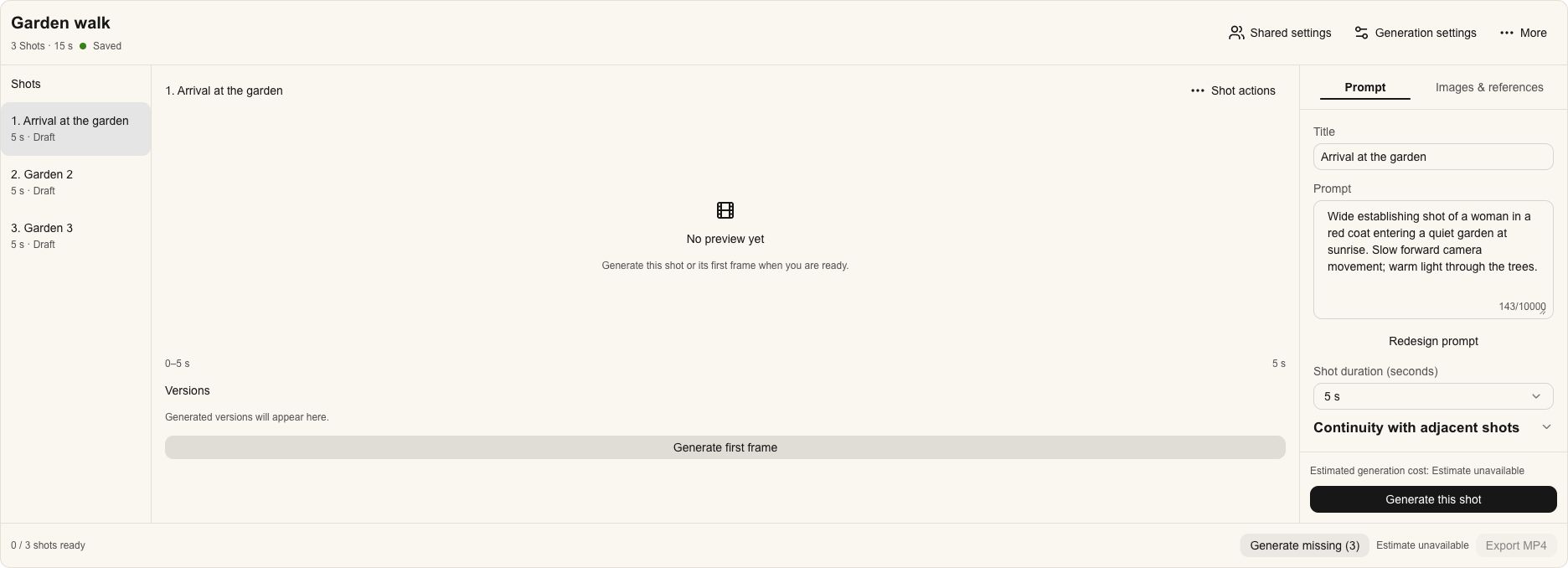
English interface with an example storyboard before media generation.
A practical workflow is:
- Review the shared settings and each shot’s prompt.
- Generate a first frame when you want to check the composition before making the clip.
- Generate individual shots, or use Generate missing to work through the remaining shots.
- Review the available versions and select one completed video per shot.
- Choose Export MP4 to combine the selected clips in sequence.
Export runs on your device, so keep the page open. A desktop browser with H.264/AAC support is a useful fallback if your device cannot export the clips. You can also download clips individually. Planning is billed separately from media generation; check the generation estimate and model settings before starting.
Batch face and head swaps: one setup, multiple combinations
The new batch workspace separates source portraits from destination images. A source supplies the face or head; a destination is the image you want to change. Choose face swap or head swap according to the area you want to replace.
Add images by uploading files or supplying image URLs. Each side supports up to 10 images, with PNG, JPEG, and WebP uploads up to 20 MB each. The workspace pairs every source with every destination: two sources and three destinations create six results. This makes it easier to compare a set of authorized portraits across several compositions without rebuilding each request.

English interface showing the two input panels before images are added.
Before generating, review the combination count, estimated total, available balance, and model settings. Confirm that each person shown is you or has explicitly authorized the swap. Once the batch starts, you can follow each task’s progress, download completed results, and retry failed tasks individually or together.
Keep the tab open while a batch runs. Its draft and batch results stay in that tab for 24 hours, so download the images you want to keep. Start with a small combination set to assess the inputs before running a larger batch.
Smaller improvements that make everyday work easier
Image and video downloads. Generated media now has direct download controls, making it easier to save a finished image or clip from the result area and bring it into your next editing step.
Model-specific image sizes. The image workspace presents size presets according to the selected model. Choose a supported format for your output instead of assuming every image model accepts the same dimensions; check the available choices again when you switch models.
Refreshed workspace design. Updated workspace styling and clearer controls support the same daily loop: enter your idea, review the settings, generate, and inspect the result. Writing, video planning, and batch swaps each have controls suited to that task.
You can use these tools independently or together: develop a short scene in writing, adapt it into a storyboard, then generate and export the clips. Open the Playground to try the workflow with your next idea.
Next steps
Move straight from this article to model details, current pricing, API documentation, and the Playground.Bring the workflow into your project
Use a complete agent prompt to build, inspect, and verify the ModelRush integration.Keep reading
Continue building the surrounding decisions in your multi-model stack.
Workflow
How to Edit Grok Images: Reproducible Prompts, Versions, and API Alternatives
Jul 4, 2026
9 min read

 ModelRushOne integration, intelligent routing, transparent billing. Model infrastructure for developers and agents.
© 2026 ModelRushAll systems operational